 |
Marettimo
Marettimo Ancient names:
Greek: Hiera or Hieronesus - Sacred
Arabic: Malitmah
Land surface and geographical position:
Km/q 12; length 7.5km (from Punta Mugnone
to Punta Bassana) width 2.5km. Coastline
19km. Height of Monte Falcone 686metres.
Position: 37°58' latitudine North and
12°4' longitude East.
Distance from Trapani 20 miles (37km), from
Favignana
13.5miles (25km) and from Cape Bon in Tunisia
70 miles (130km).
Population: Marettimo is part of the municipality
of Favignana. The island has a population
of 819 residents.
Area code: 0923.
Note
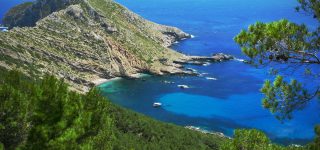
The marvellous island of Marettimo is in
a world of its own because of what it is,
its extraordinary naturalistic patrimony,
the beauty of its grottos and its very steep
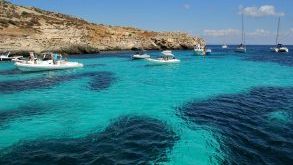
and imposing coasts that tower
above an extraordinarily iridescent , crystal-clear
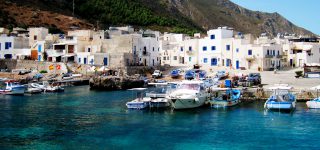
sea. Marettimo has approximately 700 residents,
all living within a small area of a mere
few square metres with narrow roads and
white lanes, squeezed between the mountain
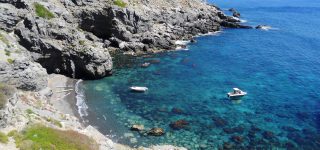
and the sea. In fact Marettimo has only
a few beaches and small, pebbly coves which
can only be reached from the sea in boats
that are available for hire.
This is the wildest, the most mountainous
and the greenest of the islands in the archipelago.
It's a luxuriant garden set in the middle
of the sea - to be more precise there are
more than 500 different botanical species,
thanks also the presence of fresh water
springs.
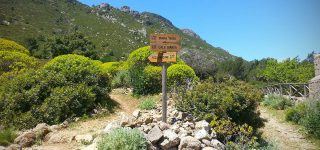
Ride on small donkeys up to the Case_Romane,
where several paths radiate outwards across
the whole island.
Itineraries:
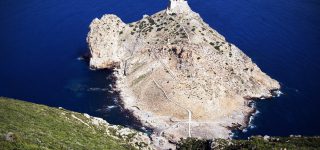
Punta.Troia. castle can be reached by sea
but is also accessible via a coastal path
that starts in the village. Arabs back in
the IX century built a look-out tower on
the promontory of Punta Troia. In 1200 Ruggero
III had it enlarged and in 1600 the Spanish
built the castle you see today, later used
as a maximum security prison.
There are still signs of the Roman civilization.
Climb the side of the mountain and in approximately
30 minutes you will reach the ruins of a
tiny group of Roman houses (Case_Romane)
and a beautiful little temple dating back
to the first centuries of Christianity,
a small byzantine church
of the XII century.
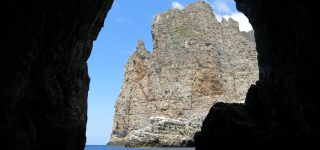
The grottos
The Grotta_Del_Cammello
is big enough for a boat to enter and reach
the gravel beach at the back of the grotto.
Up to the 1930s this grotto, located just
before Punta Troia, was home to the monk
seal, now extinct thanks to the absurd and
beastly habit of hunting them.
The Grotta_Del_Tuono
is located on the northern coast which ends
at Punta Mugnone.
The Grotta_Della_Pipa
gets its name from the shape of the homonymous
rock called Pipa
The Grotta_Del_Presepio
is so named for the stalactites and stalagmites
that have taken on the shapes of statues
in a Christmas crib due to erosion by the
sea and wind.
Grotta_Perciata
has this name because of the enormous cleft
in the rock face.
Flora and Fauna
There are woods of Aleppo pines, a thriving
maquis at Lentisco, rosemary, heather, euphorbia
and hawthorn.
The rarer plants species live on the vertical
rock faces where they are safe from the
goats: Scilla Hughy, Blupeuro and Dianthus.....
the yellow flowered Elicriso Pendulo, Sea
Fennel, Thyme and other aromatic plants
grow lower down and along the coast.
The area is rich in bird life, both migratory
and non: quail, turtle doves, doves, woodcocks,
francolin, cranes, larks, European horned
owl, storks and kingfishers.
There are falcons, kites, rooks and barn
owls high up on the summits.
Marettimo's charm lies in its waters and
sea floor and to really appreciate them
one should explore Marettimo's coast in
depth, visiting all its coves and grottos
among seagulls in flight
and fish swimming quietly among the rocks
and waving carpets of poseidonia. But even
if you don't have too much time to spend
on the island it is still well worthwhile
taking a sea trip round it. There are about
400 grottos, both above and below the water,
along the island's coast. Set sail from
the harbour heading north and you will see
that the coast immediately becomes high
and imposing, thanks to the Pizzo Capraro
massif following almost immediately by Mount
Falcone, the highest promontory in the archipelago.
Interactive
maps
|
 |